How often should you wash your home in Wellington?
The short answer is every 12–18 months. The longer answer involves which way your house faces, how close you are to the coast, and what era of paint you're working with.
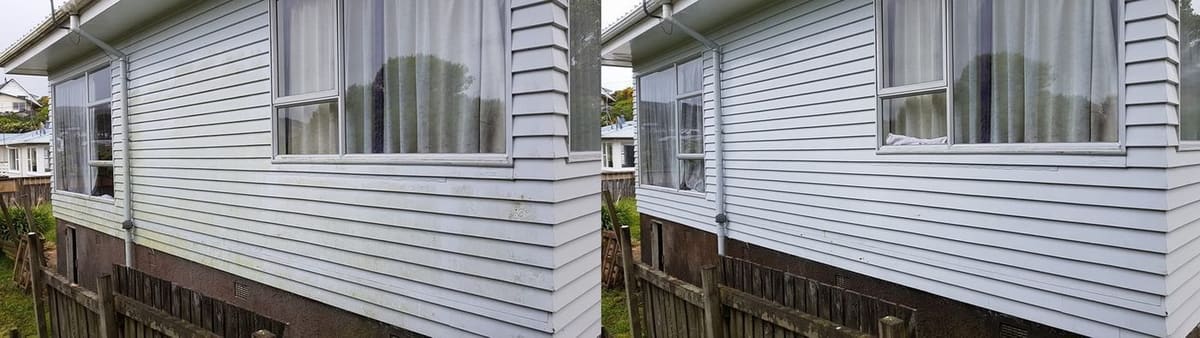
Annual wash overdue? Most Wellington homes need it every 12–18 months, send your address for a quote in 24 hours, or join the annual reminder plan.
Every 12 to 18 months for most Wellington homes. 10–12 months if you're coastal. 18–24 months if you're north-facing inland. Three factors decide which: aspect, coast distance, paint age.
The shortest answer is every 12 to 18 months. The longer answer is more interesting, and more useful, if you’d rather not pay for a wash you don’t need yet, or skip one that’s actually overdue.
After 25 years of cleaning Wellington homes, weatherboard villa to brick-and-tile, inner-city Newtown to rural Wairarapa, the honest truth is the right interval depends on three things, in roughly this order of importance:
- #1Which way your house faces
- #2Distance from coast / harbour
- #3Age and condition of paint
Year of build, weatherboard species, council zone, all near the bottom of the list. The aspect of your walls and your distance from salt water do most of the work.
North-facing properties: 18–24 months is genuinely fine
If your house faces roughly north, getting the lion’s share of the day’s sun, the wall surface dries out fast after every shower, salt deposits get baked off, and mould and mildew never quite get the foothold they need. North-facing weatherboard in a relatively sheltered suburb like Khandallah, Tawa or central Karori can comfortably go 18 months between washes. Some properties stretch to 24 months and still look reasonable.
The trade-off: north-facing walls take more UV. Paint film breaks down faster from above, even as it stays cleaner. So while a north-facing house looks like it doesn’t need much, the paint underneath is still losing its film integrity at the standard rate. Regular cleaning every 18 months helps maintain it, but the visual cue of “looking dirty” turns up later than on a south-facing house, which can fool homeowners into letting paint go too long.
South-facing properties: more like 12 months
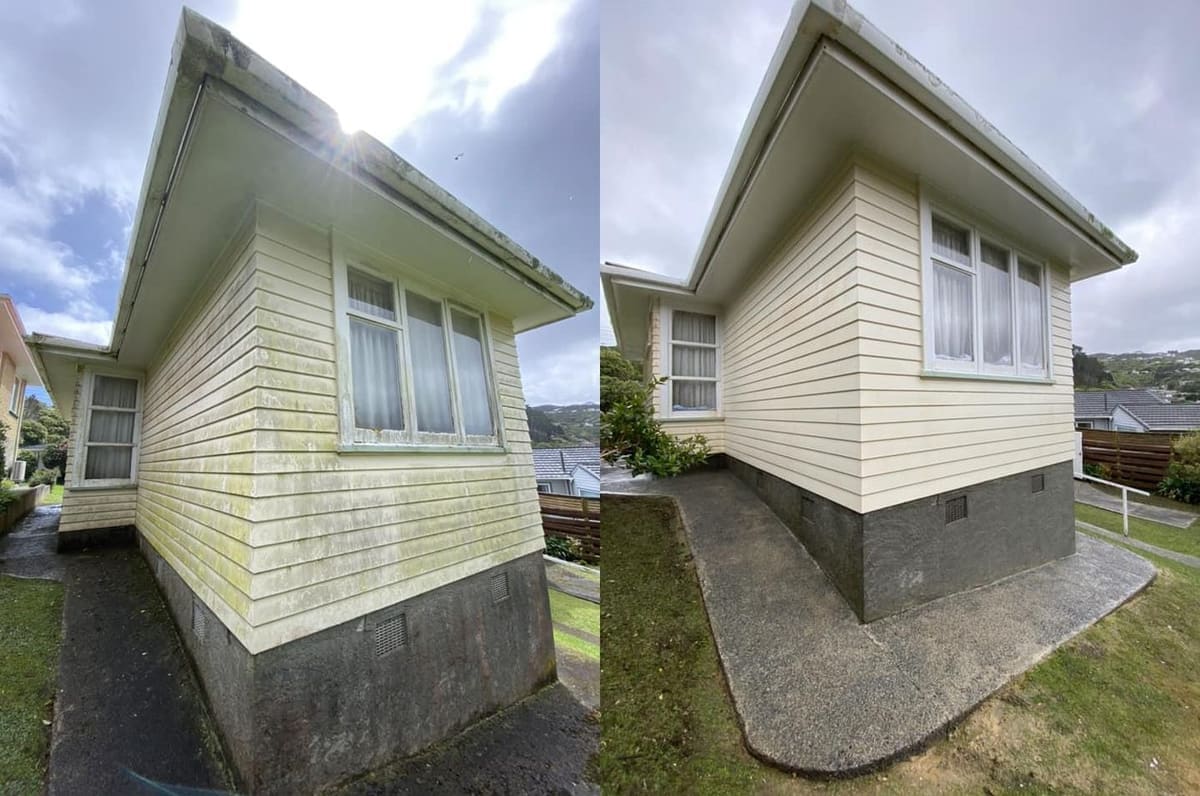
South-facing walls catch Wellington’s prevailing southerlies head-on. The wind carries moisture, the wall sits in shadow for more of the day, mould and mildew get exactly the conditions they like, and within 12 months you’ll typically see:
- Black mould patches on the lower courses
- Green lichen splotches on shaded sections
- A general “darkening” of the colour that’s just film of mould, not actual paint degradation
Brooklyn, Newlands, much of Karori west of the village, the upper streets of Kelburn, all classic south-facing Wellington territory. We recommend a wash every 12 months for these, and many of our regulars book annually in spring (before the worst of the next winter’s mould starts).
Coastal properties: 10–12 months, no exceptions
If you can hear the surf from your front door, or even from the top of your driveway, your house lives in a different cleaning regime from inland Wellington. Salt air is hygroscopic, which means it pulls moisture toward the wall, and the salt itself accelerates paint film degradation. Together with the southerly exposure that most coastal suburbs face, that’s enough to put coastal Wellington homes on a tighter cycle.
Suburbs in this category:
- Island Bay, Owhiro Bay, Lyall Bay, Wellington south coast
- Eastbourne, Days Bay, Sunshine Bay, eastern Hutt bays facing the harbour
- Petone foreshore, flat coastal strip
- Paraparaumu Beach, Raumati Beach, Waikanae Beach, Kapiti coast
- Seatoun, Karaka Bays, Breaker Bay, eastern Wellington peninsula
For most of these, every 10–12 months is the right interval. Two-storey houses with verandahs that catch salt-laden spray sometimes need a fresh-water rinse mid-cycle, though that’s edge-case stuff.
What happens if you wait too long?
The cosmetic answer is the house looks visibly aged, black streaks, green tinge, dull colour. Most homeowners notice this and book a wash before it gets bad.
The expensive answer is what happens to the paint underneath. Mould, lichen and salt deposits all sit on top of paint and slowly degrade the film.
The cost cliff: Once paint film fails enough to expose the timber, you've gone from a $250–650 wash job to a $5,000–15,000 repaint. The cheap maintenance is the early maintenance.
The danger zone is somewhere around 24–30 months for south-facing weatherboard. By then mould has often pushed through the paint film locally, and the substrate is starting to show. A wash at this point will lift most of the mould but won’t restore failing paint, you might wash and immediately find you need to spot-paint sections that have come up tatty.
Where the rules bend
A few situations don’t fit the standard intervals:
Heritage timber properties. Kelburn, Wadestown, parts of Mt Victoria and Roseneath, anywhere with 1900–1930s painted weatherboard that’s been carefully maintained for decades. These need soft wash (low pressure, biodegradable chemistry) not high pressure, and ideally on a 12–15 month schedule regardless of aspect. The paint isn’t replaceable in the same way modern paint is, and the goal is preservation, not just cleaning.
Recently painted (under 18 months). New paint can sometimes be a bit too soft for any wash. Wait at least 18 months from paint completion before the first clean. If you’re not sure how old the paint is, your painter or builder will know.
Rental properties. Landlords often skip the cleaning cycle and then face a much bigger paint job between tenants. Twelve months between washes is a much cheaper insurance policy than the alternative.
Pre-sale. If you’re selling, a wash 4–6 weeks before listing photos is one of the highest-ROI prep jobs you can do, pre-sale wash budget is rarely more than $500, and the difference in kerb appeal is the difference between a property that photographs well and one that doesn’t.
Quick reference
| Aspect / location | Interval | Why |
|---|---|---|
| North-facing inland | 18–24 months | Dry, UV-aged, low mould pressure |
| South-facing inland | 12 months | Shadowed, moist, mould-prone |
| Coastal (any aspect) | 10–12 months | Salt + southerly + moisture |
| Heritage timber | 12–15 months | Preserve paint, soft wash only |
| Recently painted (<18 mo) | Wait it out | Paint still curing |
| Pre-sale | Once, 4–6 weeks before listing | Kerb-appeal ROI |
How to know it’s time
Two practical tests you can do in 60 seconds:
- Wet-finger test: Run a wet finger along a south-facing weatherboard. Grey-green tinge on your finger = mould has a foothold and you're due.
- Spouting check: Look at the underside of your spouting in good light. Visibly green or black = the rest of the house is the same, you just haven't noticed yet because spouting is at eye-level for spotting it.
If either reads yes, get a wash booked. If both come back clean, you’ve got another season or two.
Want a Wellington-specific quote?
Send through your address and I’ll quote off a couple of photos within 24 hours. Usually back within a few hours, and yes, I do the wash myself.
James, Clear Water Blasting Services. Owner-operated since 2001.

Written by James · Clear Water Blasting Services
Owner-operated since 2001 from Johnsonville. James does every quote and every job himself across Wellington, the Hutt, Kapiti, Porirua and the Wairarapa.

From the blog
Most recent posts

House washing in Wellington's coastal suburbs, Lyall Bay, Kilbirnie, Seatoun, Island Bay and Miramar
Why coastal Wellington homes age twice as fast, and what to do about it. A practical guide to salt-spray, southerly exposure and the cleaning regime that actually works.
Read →
Soft wash vs water blasting: which does your house actually need?
Same trade, two very different tools. Soft wash protects painted surfaces; water blasting strips them. Knowing the difference matters.
Read →
Moss treatment in Wellington: soft wash, spray, or scrape, which actually works?
Wellington's damp climate grows moss faster than almost anywhere in NZ. Three treatment methods, which one fits your roof and walls, what each costs, and how long results last.
Read →


